
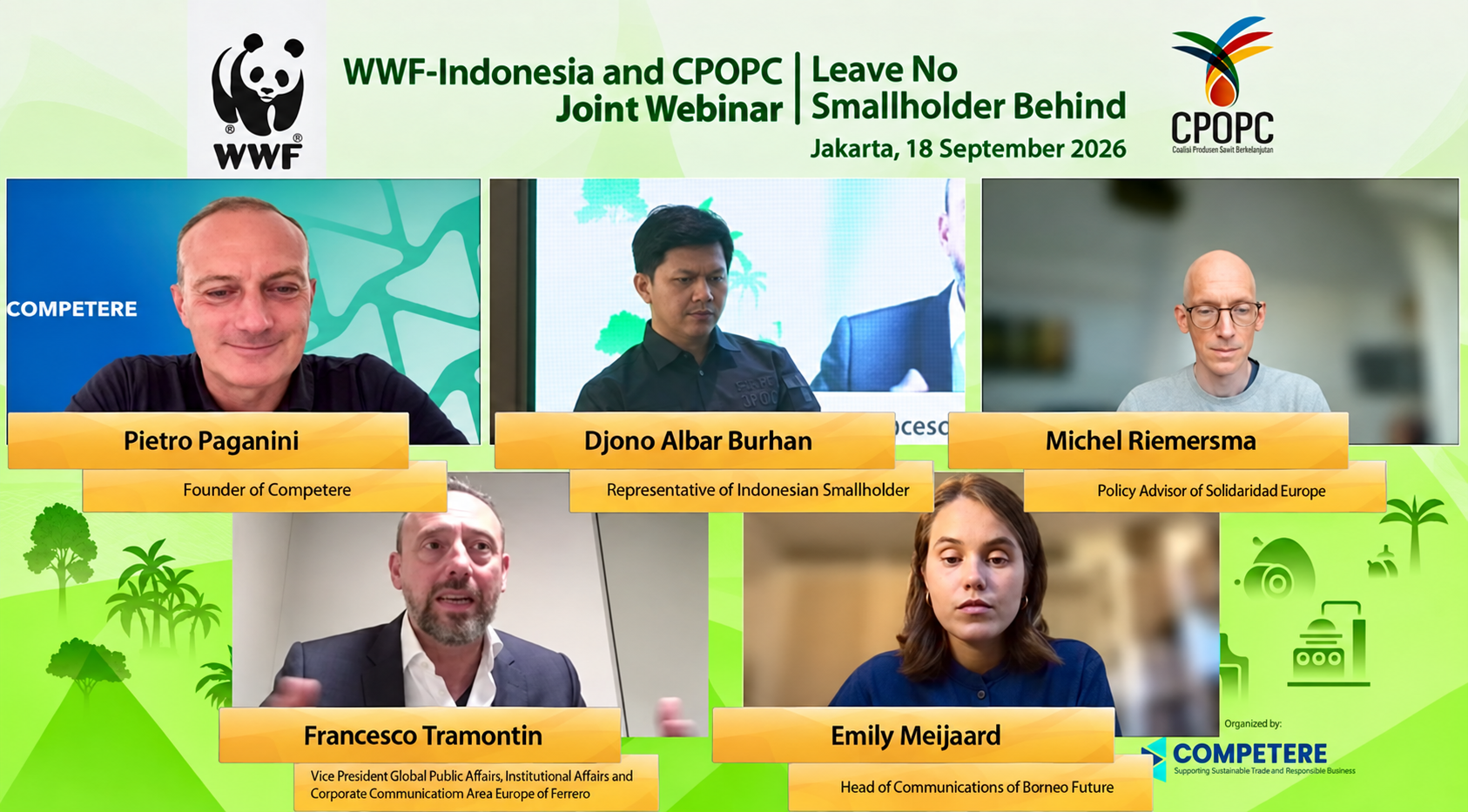
Smallholders are not a marginal part of the palm oil sector. They account for around 32–35% of production in Indonesia and 15–17% in Malaysia. An estimated 15–17 million smallholders could be affected by the implementation of the EUDR, yet their voices remain underrepresented in the policy debate.
- Djono Albar Burhan, APKASINDO
- Emily Meijaard, Borneo Futures
- Francesco Tramontin, Ferrero
- Michel Riemersma, Solidaridad Europe
In a nutshell:
- Smallholders are ready, but compliance comes at a cost: mapping, traceability, certification and documentation require resources that many farmers cannot access.
- Sustainability must be a shared responsibility: governments, companies and consumer markets must help finance the infrastructure and support needed for EUDR compliance.
- The EUDR can become an opportunity, not a barrier: better data, technical assistance and stronger farmer organizations can protect market access while improving rural livelihoods.
Ready to Change, but Who Pays?
The central obstacle is not resistance to sustainability. Smallholders in Indonesia and Malaysia are ready to improve traceability and meet higher environmental standards. The real barrier is the cost of doing so.
Geolocation, certification and record-keeping require money, technology and technical knowledge. Many independent farmers already struggle to access credit, making the upfront investment particularly difficult. If these costs are simply pushed down the supply chain, they will ultimately be borne by those with the least capacity to absorb them.
This raises a fundamental question: who pays for sustainability? Consumer markets cannot demand increasingly sophisticated systems while leaving producers alone to finance them.
When Legality Starts with a Map
For many smallholders, compliance begins with proving where their land is and demonstrating the legal right to farm it. In practice, formal mapping can be expensive and inaccessible. Farmers may have cultivated or inherited land for generations without possessing the documentation recognized by administrative systems.
Without workable solutions for mapping, geolocation and documentation, farmers could lose access to international markets, not because they are linked to deforestation, but because they cannot produce the required evidence.
Compliance Needs Infrastructure, Not Just Commitments
The discussion highlighted a broader shift from voluntary sustainability commitments to mandatory compliance. This can strengthen accountability, but regulation alone cannot build the infrastructure needed to deliver results.
The EUDR should create a more coherent and inclusive framework than fragmented company-led initiatives, provided that the necessary systems and investment are put in place. Certification can support due diligence, but it is only one part of the solution. Effective implementation also requires reliable data, traceability tools, clear standards and incentives that allow smallholders to enter compliant supply chains.
Local Knowledge Can Lower the Cost
Community-based approaches can reduce costs while drawing on farmers’ knowledge of their environment. They can also help identify pests, target interventions, reduce pesticide use and strengthen awareness of conservation.
Most importantly, such systems give smallholders ownership of the sustainability process instead of treating them as passive recipients of external requirements.
Responsibility Must Run Through the Supply Chain
Government-to-government cooperation between EU Member States and producing countries is key, supported by financial instruments and national initiatives. The same principle applies throughout the value chain: companies must invest in implementation, governments must create enabling systems and consumer countries must help finance the transition.
Support must also be understandable. Smallholders need clear information on what the EUDR requires, where assistance is available and who will cover additional costs. Existing national certification systems should be recognized as building blocks wherever possible, avoiding unnecessary duplication.
If implemented inclusively, the EUDR could deliver more than regulatory compliance. Better farm data could help governments target support, while stronger farmer organizations could improve access to finance, training and technology.
Deforestation-free supply chains cannot be built by excluding the people at their first mile. If the EUDR is to succeed, smallholders must not merely comply with the transition, they must be equipped to benefit from it.