
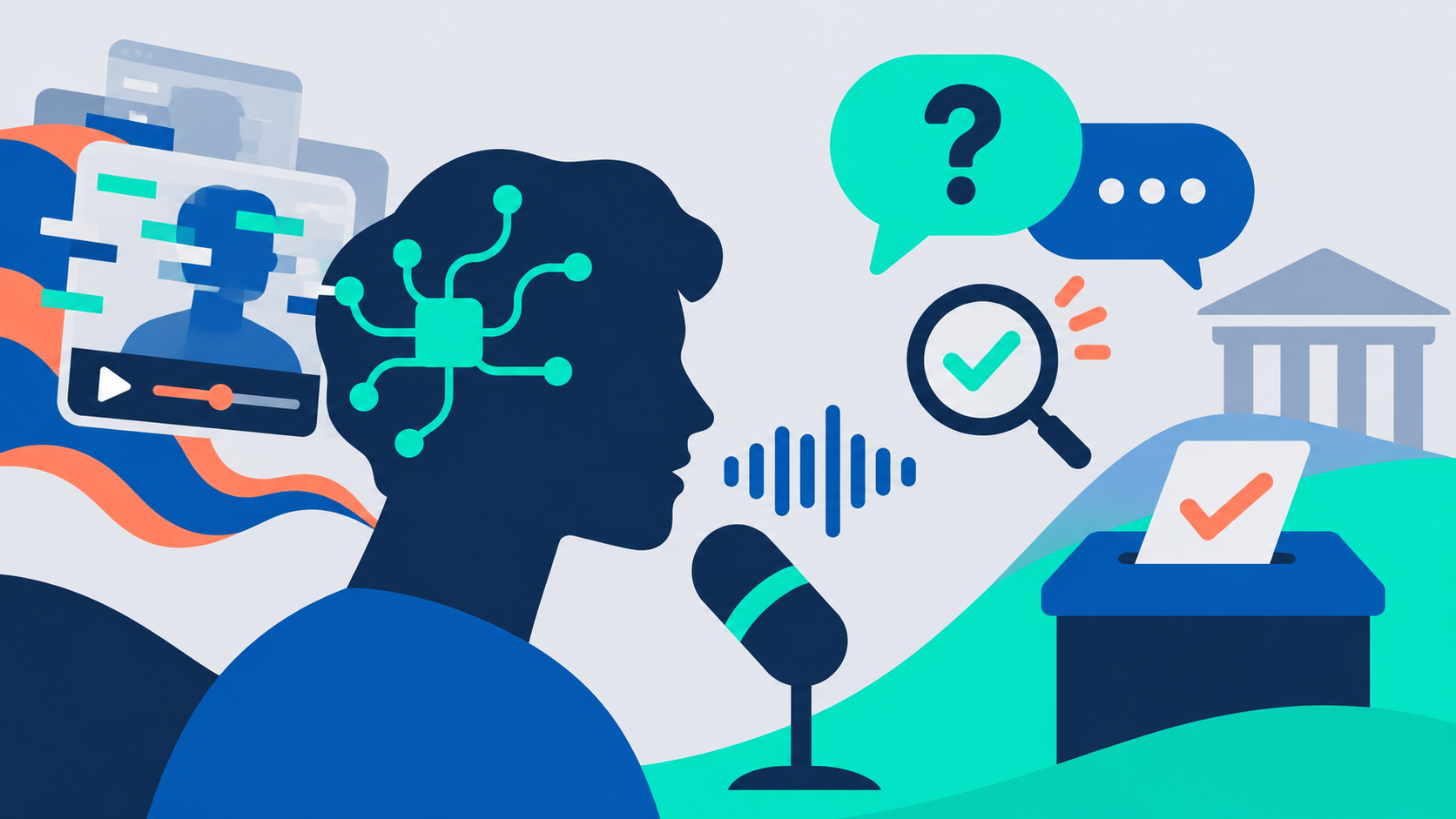
Pietro Paganini joined Marco Cerrone on Puntini sull’AI, a podcast by Radio Radicale, to discuss how artificial intelligence is transforming political propaganda, electoral communication, and democratic decision-making. Starting from Giorgia Meloni’s application to register her voice as a sound trademark, we explored the risks of deepfakes, cognitive manipulation, and the growing temptation to outsource our political judgment to AI. But AI can also become a powerful instrument of democratic empowerment, helping citizens question political promises, challenge their own convictions, and make more informed choices.
Watch the full episode here, or explore the key highlights below.
In a nutshell:
- AI amplifies propaganda, but does not invent it. Deepfakes and personalized messages exploit existing cognitive biases.
- The real danger is cognitive outsourcing. Delegating political judgment to AI risks weakening our capacity for independent thinking.
- Democracy needs critical thinking, not a Ministry of Truth. Education, transparency, and individual empowerment are more sustainable than censorship.
When a Voice Is No Longer Proof of Identity
The conversation with Marco Garrone began with an intriguing case: Italian Prime Minister Giorgia Meloni’s application to register the phrase “Io sono Giorgia Meloni” as a sound trademark.
The case raises a broader question: what does it mean to protect someone’s identity when artificial intelligence can reproduce their voice and make them say things they never said?
A sound trademark may offer protection against certain unauthorized commercial uses, but it cannot provide universal protection against AI-generated impersonation.
The challenge goes beyond intellectual property. AI is breaking the traditional relationship between a person’s voice and the authenticity of their words.
We must increasingly ask not only whether a statement is true, but whether it was ever made.
Propaganda Exploits How Our Minds Work
Political propaganda existed long before artificial intelligence. What AI changes is its scale, speed, cost, and potential for personalization.
Political messages can increasingly be adapted to different audiences, exploiting their fears, expectations, and existing convictions.
One of the most powerful mechanisms is confirmation bias: our tendency to favor information that supports what we already believe.
This distinction matters when evaluating political communication. A message that generates millions of views or shares does not necessarily persuade undecided voters. It may simply reinforce existing beliefs and mobilize those who already agree.
Political engagement is not the same as political persuasion.
Another emerging risk is the liar’s dividend: as synthetic content becomes more widespread, authentic recordings can also be dismissed as fake.
AI can therefore undermine trust in two directions: making falsehoods appear credible and genuine evidence appear questionable.
From Cognitive Outsourcing to Socratic AI
Yet artificial intelligence should not be understood exclusively as a threat to democracy. It can also become an extraordinary instrument for improving political awareness and individual decision-making.
The critical question is how we use it. If we ask AI to tell us which candidate to support, we risk outsourcing our political judgment. Instead of strengthening our intelligence, we may gradually weaken our capacity to think independently.
Paganini proposed a different approach: the Socratic AI agent.
Imagine an AI assistant that helps citizens compare electoral programs, verify political promises, identify inconsistencies, and examine the strongest arguments against their preferred candidates.
Rather than confirming our beliefs, it should challenge them.
This reflects a fundamental principle of critical rationalism: our convictions become more robust when we expose them to criticism and attempts at refutation.
A good electoral AI assistant should not make us more comfortable with our political choices. It should make us think harder about them.
Protecting Democracy Without Creating a Ministry of Truth
The discussion also addressed the European AI Act, the prevention of electoral deepfakes, and the responsibilities of institutions and digital platforms.
AI-generated manipulation requires effective responses. But fighting disinformation must not become an excuse to restrict legitimate political criticism, satire, or freedom of expression.
We need to distinguish deliberate deception from parody and political disagreement. When harmful falsifications circulate, interventions should be timely, transparent, proportionate, and open to independent review.
Prevention, however, cannot depend exclusively on regulation. Schools, universities, independent institutions, and civil society have a fundamental role in developing digital literacy, critical thinking, and the ability to evaluate competing arguments.
The objective should not be to protect citizens from every potentially misleading message, but to strengthen their capacity to recognize manipulation and exercise independent judgment.
Democracy Needs Citizens Who Think
The greatest democratic opportunity offered by AI is not the automation of political decisions. It is the possibility of making citizens better informed, more critical, and more capable of questioning political power. Technology should expand individual agency, not replace it.
Democracy does not need algorithms that decide what citizens should think. It needs citizens capable of questioning algorithms, politicians, and their own convictions.
That is the difference between artificial intelligence as an instrument of manipulation and artificial intelligence as an instrument of freedom.