
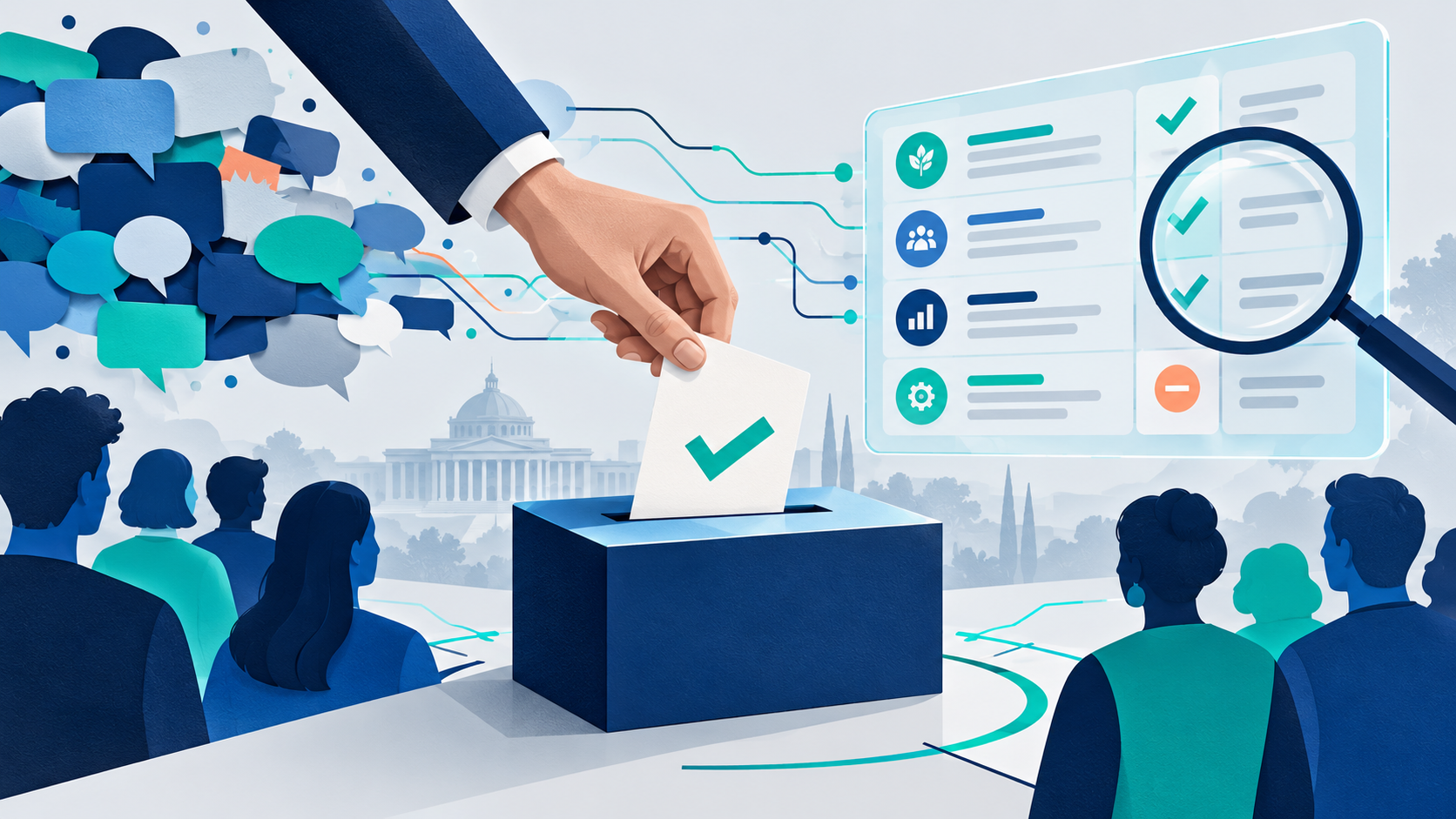
Artificial intelligence can make propaganda more convincing, but it can also help voters recognize it. Ahead of Italy’s 2027 elections, the debate goes beyond deepfakes and disinformation: AI can help citizens compare political platforms, check campaign promises, and hold politicians accountable for results. The challenge is to turn this potential into knowledge, autonomy, and freedom of choice.
In a nutshell:
- Artificial intelligence enters the political contest. In Italy’s 2027 elections, AI could help shape political platforms and inform citizens, alongside producing campaign messages. Opportunities are growing, together with the risks of propaganda and disinformation.
- Making promises is easy. Checking them could be too. By comparing proposals, identifying contradictions, and tracking commitments, AI can give voters more tools to scrutinize results and demand greater accountability.
- AI informs. Citizens decide. Comparing political platforms may become easier, but judgment cannot be delegated. Transparent sources, pluralism, and critical thinking are essential to turn information into freedom of choice.
AI in Politics: Manipulation or Informed Choice?
Imagine two voters during an election campaign. The first watches an AI-generated political video on social media without realizing it is fake. The second uses the same technology to check the video’s promises against the parties’ platforms. The same tool, two opposing possibilities: manipulation or informed choice.
Italy’s 2027 general election could be the first in which artificial intelligence (AI) plays a significant role not only in communication, but also in developing political platforms and informing citizens.
The debate focuses on the risks: deepfakes, disinformation, and interference. These are real. But fear overshadows the opportunities offered by a technology that can expand knowledge and autonomy.
AI-Generated Propaganda: The Value of Authenticity
The first shift is already visible. AI makes it possible to produce videos and messages at lower cost, tailor them to different audiences, and measure their reactions. Even small parties can access tools once reserved for larger ones.
Yet the same tools can fabricate statements that were never made and spread misleading content. The 2024 US presidential election demonstrated these uses; November’s midterm elections will provide another testing ground, although direct comparisons with Italy should be treated with caution.
There is a paradox: the easier it becomes to craft perfect messages, the more voters may value the authenticity of those who respond without filters.
Political Platforms: AI Analyzes, Politics Decides
The second shift concerns political platforms. AI will do more than communicate them: it will help write them. A party seeking to boost Italy’s productivity will be able to analyze data, compare policies across countries, identify inconsistencies, and assess scenarios more quickly.
These analyses will need to be checked, but even small parties will be able to develop better-supported proposals. There is also an opposing risk: similar tools and sources could produce increasingly uniform platforms.
Politics, however, is not technical optimization: it is about choosing between values and priorities. AI can clarify the alternatives, but it cannot decide what kind of society to build.
Better-Informed Voters: Putting Promises to the Test
The third and most profound shift concerns voters. Imagine a self-employed parent of two asking an AI assistant: “How do the parties differ on taxes, education, and healthcare?” Or: “Which promises can be funded? Which commitments from the previous parliamentary term were fulfilled?” Answers that currently take considerable effort to obtain could become accessible to more citizens.
Television, newspapers, and social media will remain central: chatbots and AI agents will not replace them for several years yet. But AI will begin to act as an intermediary between sources and the public, helping people find and interpret information. This creates an opportunity to change political incentives.
If comparing promises with results becomes straightforward, parties will find it harder to hide contradictions behind slogans. Political platforms could evolve from campaign documents into commitments that can be tracked over time.
This is not guaranteed: AI makes mistakes, and not every promise can be measured with a number. But better-equipped citizens can demand more coherent proposals and greater accountability.
Freedom of Choice: Judgment Cannot Be Outsourced
One crucial question remains: who selects the sources, and how are the alternatives presented? AI is becoming a new political intermediary, capable of shaping understanding even unintentionally.
The risk of cognitive outsourcing is that we delegate not only the search for information, but judgment itself. We can ask AI to compare political platforms, but not to decide what we believe is right.
An open society needs pluralism, transparency, and critically minded citizens, not digital oracles.
From Propaganda to Informed Choice: The AI Challenge
The real shift will not be enabling politicians to communicate better with voters, but enabling voters to question politicians more effectively.
AI will make propaganda easier to produce, but it could also help expose it. The challenge is to turn this potential into knowledge, autonomy, and freedom of choice.