
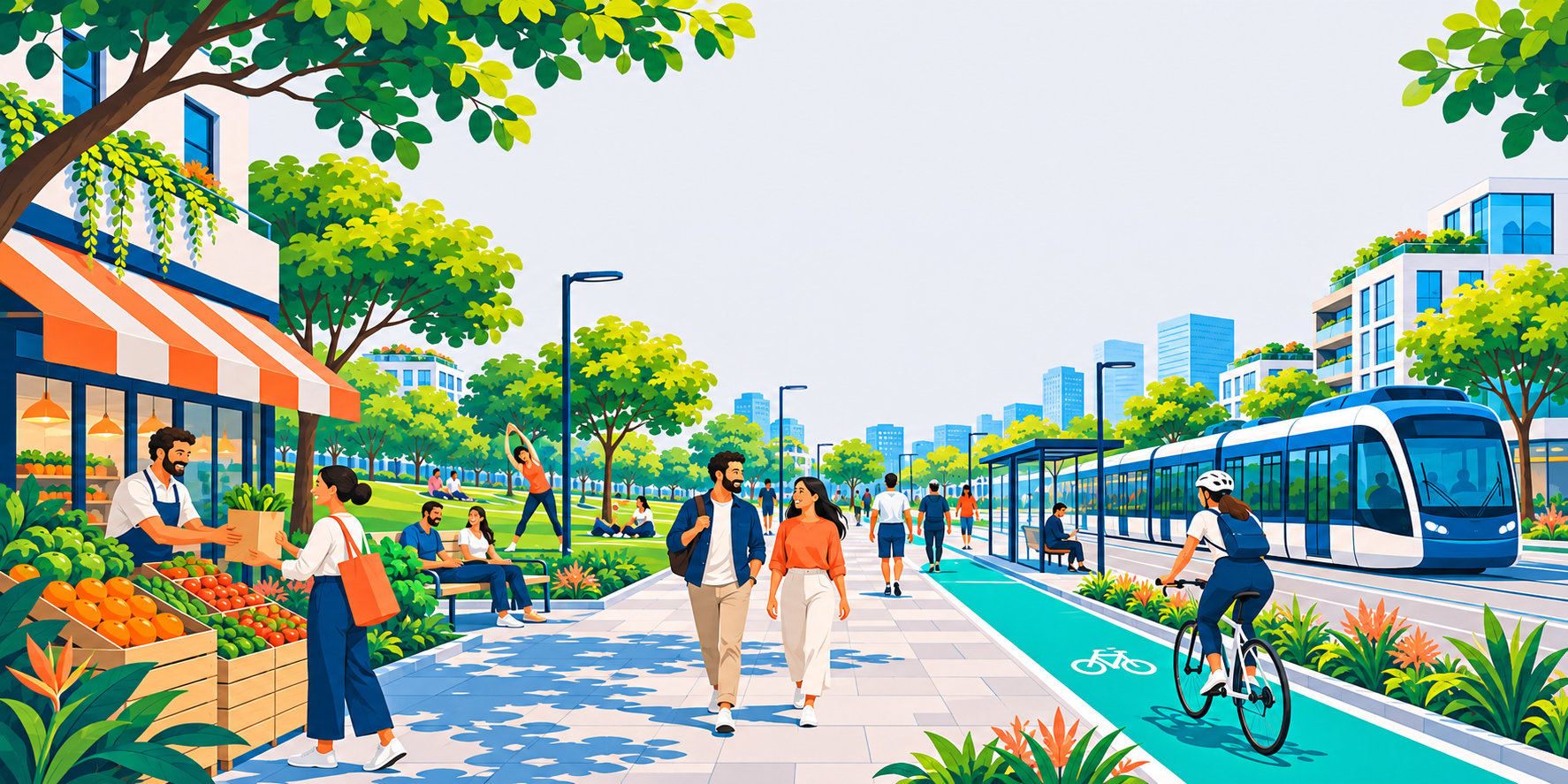
Healthier cities are not built through infrastructure alone, but through policies that expand individual opportunities and make healthy choices more accessible. From mobility to food access, smarter urban planning can empower people, encourage innovation and deliver measurable public health benefits.
In a nutshell:
- We are free to choose. But we do not all start with the same opportunities. Living near a park, having access to efficient public transport, or being able to easily reach shops and services shapes the options available to us every day.
- Prevention does not depend on individual behaviour alone. The environment we live in can make some choices easier, more expensive, or practically impossible.
- Smart policies expand people’s options rather than prescribing how they should live. Urban planning, innovation and competition can create better conditions while respecting individual preferences.
Same freedom. Same possibilities?
World Cities Day, celebrated on 31 October under the motto “Better City, Better Life,” offers an opportunity to reflect on a frequently overlooked dimension of public health: the environments in which we live can make healthy choices easier, more difficult, or simply unavailable.
Better prevention requires more than influencing individual behaviour. It also means creating the conditions that allow people to take greater responsibility for their health.
The Hidden Health Costs of Urban Living
More than 55% of the world’s population lives in urban areas, a share projected to reach 68% by 2050. Yet urban growth does not automatically translate into healthier living conditions.
Consider physical activity. According to the World Health Organization (WHO), approximately 1.8 billion adults worldwide did not meet recommended physical activity levels in 2022.
Urban design can influence everyday movement. Long distances, car-dependent neighbourhoods and unsafe streets can make walking or cycling impractical. Conversely, accessible public spaces and efficient transport networks can create opportunities to incorporate physical activity into daily routines.
Air pollution presents another challenge. The WHO estimates that outdoor air pollution contributed to approximately 4.2 million premature deaths worldwide in 2019. Road transport is an important source of urban air pollution, although its contribution varies considerably across cities.
These challenges illustrate a broader point: individual behaviour and the surrounding environment are interconnected.
Encouraging people to walk more is useful. Making walking a safe, convenient, and realistic option can make that encouragement more effective.
Healthy Choices Should Be Accessible Choices
The relationship between urban environments and health extends beyond mobility and air quality.
Access to nutritious food is another important dimension of prevention. Yet availability, affordability and convenience differ significantly across neighbourhoods and income groups.
In 2024, 8.5% of the EU population was unable to afford a meal containing meat, fish or a vegetarian equivalent every second day. Among people at risk of poverty, the proportion reached 19.4%.
These figures highlight the importance of affordability in discussions about nutrition and public health.
However, access to healthy nutrition should not be reduced to the availability of fresh produce alone. Safe, nutritious and diverse food options, including appropriately processed and preserved products, can contribute to balanced diets.
Prices, infrastructure, food distribution, consumer preferences and nutritional knowledge all influence people’s ability to make informed choices.
Better Policies Should Expand Opportunities
If urban environments influence health, how should policymakers respond? The objective should not be to prescribe a single model of healthy living, but to expand the opportunities available to individuals.
1. Make healthy choices easier. Walkable neighbourhoods, accessible green spaces, safe cycling infrastructure and reliable public transport can facilitate physical activity and improve quality of life.
Similarly, policies that encourage competition, efficient distribution and innovation in food systems can help improve access to affordable and nutritious products.
The goal should be to remove unnecessary barriers, not replace individual preferences with centrally prescribed behaviours.
Businesses, entrepreneurs, researchers and local communities can contribute solutions, from smarter mobility services and digital infrastructure to more efficient food distribution systems.
Public-private cooperation and technological innovation can help cities address complex challenges while making better use of limited resources.
A new cycling lane is not necessarily a public health success simply because it has been built. Its value depends on whether it improves mobility, safety, accessibility and, ultimately, people’s opportunities to be physically active.
Better urban policies require measurable results, careful assessment of costs and benefits, and a broader approach to prevention that connects mobility, food access, innovation and individual well-being. Europe’s challenge is to create cities where healthier living becomes more accessible, affordable and compatible with people’s different needs and preferences. Success should be measured by the opportunities cities create, not simply by their infrastructure or environmental targets.
A healthier city is not one that tells people how to live. It is one that gives them more opportunities to live well.